Rapid shifts in economic and trade policy create a sense of uncertainty going forward.
We already have a major international incident three days into 2026 as the Trump administration captures Venezuelan President Maduro and changes dynamics in the southern hemisphere.
But I’m not going to jump into the new year just yet. Instead, I want to take a moment to review the major fiscal policy decisions from 2025 that had the most effect on the markets.
Tariffs: A major economic shift
President Trump introduced a flat 10% baseline tariff on imports and country-specific tariffs in April. This move caused immediate market reactions, with both the Dow Jones Industrial Average and the S&P 500 plummeting after the announcement.
The decision to pause tariffs for some countries, just days later, created additional confusion. Markets began to recover, even as the baseline tariffs and higher tariffs remained. Trade-deficit partners such as Canada, India, Brazil, and China, continue to experience elevated costs.
The U.S. GDP contracted by 0.6% in the first quarter of the year, in part because of the tariff policies and investor uncertainty about the US. However, this appeared to recover in the next few quarters, although investments continued to drag.
The overall inflation rate has thankfully stabilized at just under 3%, even as affordability continues to plague Americans. Over half said in a survey that they felt the cost of living rose in 2025. This may be due to specific price surges on stables like coffee, beef, and housing.
In an attempt to stimulate the economy, the Federal Reserve has begun cutting interest rates. The current range encompasses 3.50%-3.75%. While the stepped approach hasn’t significantly affected mortgage rates or auto loans, it signals potential relief.
Emerging Markets Rise to the Top
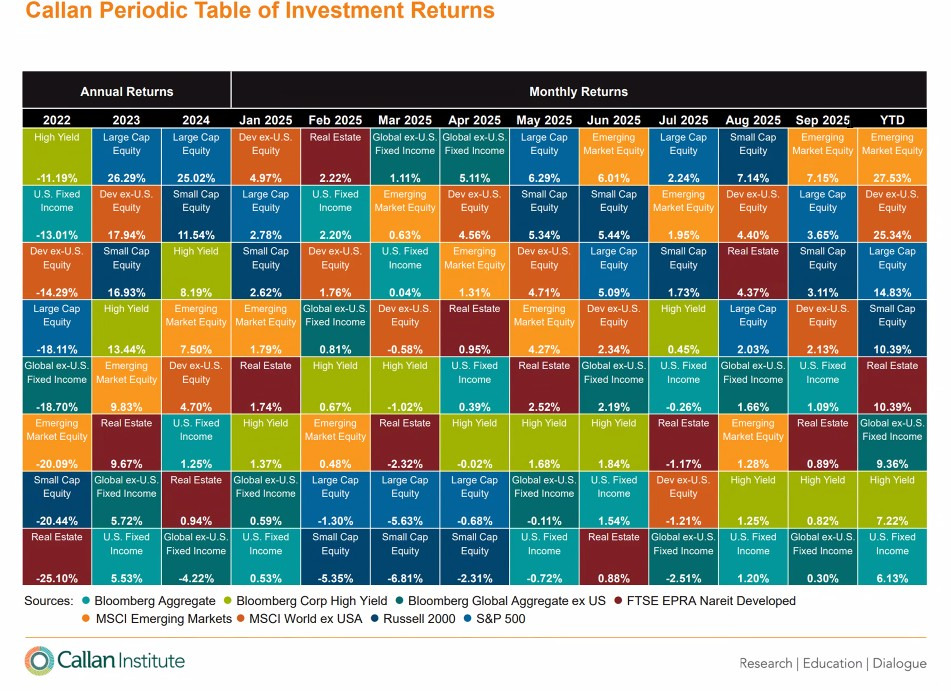
Callan releases a periodic table of investment returns monthly and annually, organized from best to worst in a periodic table format. The full 2025 table won’t be released for another few months, but we can see a clear trend from January through September: Emerging Markets gained in value.
This asset class has been gradually climbing the ranks since 2022. While it dropped towards the bottom of the chart twice during the year, it finished September with a whopping 27.53% returns. U.S. fixed income assets, meanwhile, sunk to the bottom.
Positioning for 2026
This much is clear: We’re seeing a dramatic adjustment in inflation, interest rates, and investing. There are so many variables in the economy and markets, let alone individual portfolios, it’s impossible to give specific recommendations. However, the volatility suggests that it’s more important than ever to rely on diversification and emergency funds.
Diversity your portfolio
It is essential to ensure that your investments are varied and diversified. This is a best practice in investing, and I’ve rarely seen it not be effective for mitigating risk. With so many variables in the current economy and shifting fiscal policy, it’s important to ensure your portfolio value is protected.
One particular aspect of diversification I want to highlight is geography. Let me explain.
I’ve been “riding the train” of the current administration. One element that has been beneficial is creating a portfolio that is exclusively non-US assets. This approach has allowed me to diversify portfolios and mitigate the effects of US-based uncertainty. This is not a recommendation, but one example of diversification.
Refine your emergency fund
With so many uncertainties in the economy, you want access to cash. Outside of taking out your minimum payments, you’ll want to have an emergency fund in place. What could this look like? Here are some best practices for building a resilient emergency fund:
Save at least one year’s salary plus 20% for buffer
Keep at least one month’s income in hard cash
This should be in cash, ideally in a high-yield savings account
Use a cash management account instead of a bank account for additional security
Stay updated with market news
There’s a lot of noise out there about how to invest. The truth is: No one knows the best path for you until they see the specifics of your goals and your portfolio. However, you can gain clarity from expert insights.
Sign up for our monthly Beyond the Numbers newsletter to stay informed about investing and economics trends. If you’d like more hands-on help with your portfolio, you can book a complimentary discovery call today.
Want a second opinion?
Want some feedback on your retirement plan? We can help.
With over 40+ years of experience in the financial sector, and as a licensed fiduciary, founder Jon Green can help you look over your retirement plan and understand whether you are on track.
What are we doing over at Encompass Advisors? When we aren’t speaking with clients, we are watching the markets and running numbers. Get our latest, in-depth insights here.