Jenga, a block-stacking game based with its origin in Ghana, reached North America in the late 80s. The premise was simple: Build a tower out of thin blocks, then each player removes a block and places it on top of the tower. The player who causes the tower to fall loses.
Today, the complete restructuring of our federal government and economy looks more like one of these jenga towers than a sound structure.
Adapting monetary policies for a changing world is never easy, but most people I speak to, from fund managers to clients and neighbors, feel overwhelmed. Almost everyday there is a cascade of new “deals” and systemic changes to policies across government departments. In some cases, we are given conflicting information. It’s confusing.
And,this is my personal judgement, I think it’s simply a fact that this is the least technically competent and least qualified administration of my lifetime. They aren’t even bringing their A-game because they seem more interested in impressing the president than effectively running their departments. Loyalty politics is never positive for the people, regardless of the party in power.
To me, the economy resembles a Jenga tower. We watch, daily, as block after block of the tower is pulled out. We wait for the tower to fall.
There’s no way to predict or project how the economy will react to each change. Too many interconnected variables are in play to adjust them all and determine the “end result” of where our economy will be a year from now, let alone a week from now!
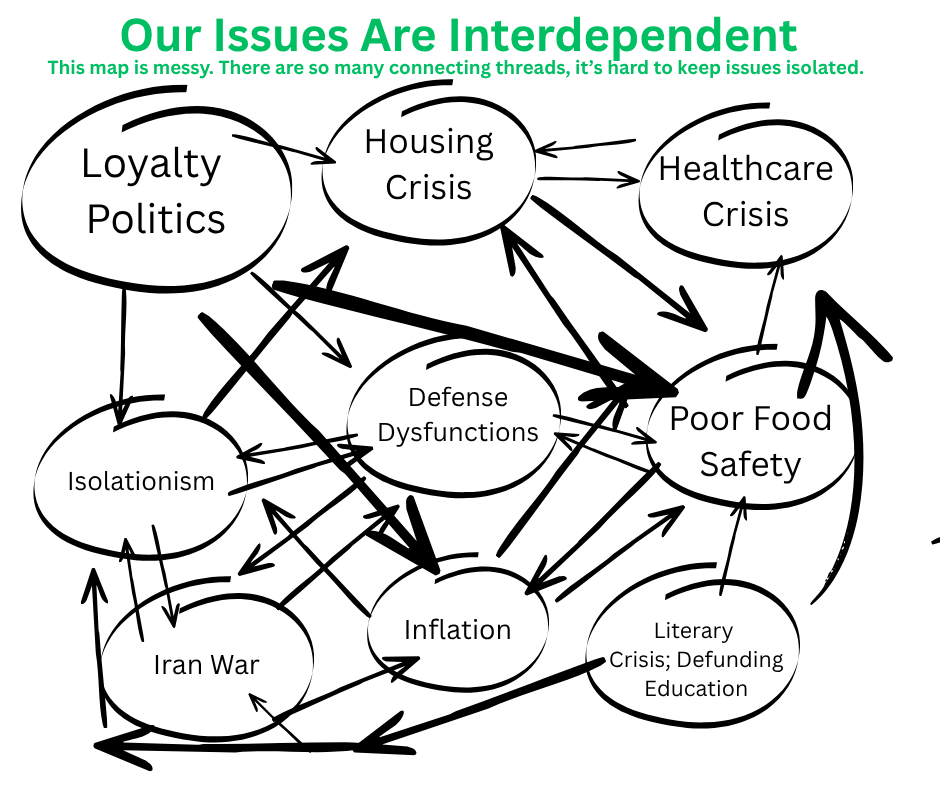
This article delves into that interdependence. I want to discuss this tower, what these interconnected variables are, and reassessing risk in uncertain times.
From the Top of the Tower – What Can You See?
From the top of the Jenga tower, you only see glimpses of single issues. Rising gas prices. Unemployment. Midterms.
As humans, it’s often easier to look at issues this way, too. It feels that they are easier to understand and “solve” if we compartmentalize them. But that has become impossible if we want realistic solutions.
Fiduciaries and advisors, I argue, can’t compartmentalize them effectively. To do so leaves our clients open to risk. It’s challenging to find a monitor big enough to display the big picture, but we must get as close as possible to provide well-researched financial advice.
Assets from commodities and gold to stocks, bonds, and real estate all hinge on a complex web of variables like those above. Many are economic. Moreover, these days these variables are increasingly political. More of them than I would like are becoming controversial. But that’s where we are.
It is easier to plan ahead if you can determine two things:
Trusted sources of information.
The connection between multiple events or policy changes.
The Foundational Issue: Trust
If nothing else: The underlying issue is information accuracy. It is challenging for professionals across the board to take data from the government at face value. Before diving into the Treasury, let’s review some of the past decisions that have made official data questionable:
After dismal job growth in 2025, President Trump appointed a new Bureau of Labor Statistics head that would give “accurate” numbers—something never done before. Some are concerned if we can trust the numbers fully, when the position is no longer objective.
Natalie Harp, the assistant to the President, failed to comply with security review or apply for her clearance, but has been given access to the President and dictates his social media communications. More people are becoming skeptical about what this means for the authenticity of the President’s communications.
The White House has also been pulling previously published, verified data, such as a vaccine study. They have also altered nearly 400 datasets.
The DOGE fiasco remains a concerning event, in which claimed “waste and fraud” dollars continued to shrink and many of the fired employees were rehired to much-needed positions.
All of this leads to financial-specific factors: The financial decisions under Secretary of the Treasury Scott Bessent, whom many, including myself, thought was initially more dependable given his extensive history in banking and finance. He exhibited restraint in the beginning of the President’s term, appearing to look at the fiscal situation with more gravity than others in the cabinet.
However, as national debt issues compound, it’s harder to trust his methodology. Let’s consider his recent focus of working to drop interest rates and collect investments in US Treasury bonds—an essential move to drop the yield curve. Typically, one would use long-term bonds here, because they are significantly more attractive.
Bessent is not doing that.
Instead, he’s buying back older bonds and releasing short-term bonds, saying this will help lower the debt.
But the debt is still $40 trillion dollars. And the obligations outpace revenue coming in.
In other words, it doesn’t matter if there are new, short-term bonds, because that income still can’t keep up with spending. Nevermind the fact that Treasury bonds require investors—investors that feel that the return is worth it. But short-term bonds offer lower rates in a period of high inflation and volatility, making them unattractive.
It’s not surprising that some experts are skeptical of Bessent’s strategy. And it’s not just about what he’s saying. Many are reviewing his most recent track record before entering the government.
Consider his hedge-fund, Key Square. Now, hedge funds are supposed to generate significant returns. But from the period he and his partner started with $500 billion in 2018 and when Bessent ran the fund on his own shortly after, the fund took a nosedive. By the time it closed in 2024, the fund had been reduced to $500 million.
And the question arises: Is this someone we can trust to run the country’s Treasury?
Every day that we move away from financial stability, the more critical that question becomes.
The Blocks in Our Economic Jenga Tower
There are dozens of moving parts after we consider that the foundation is shaky. Let’s try to connect several of them:
America’s shift towards isolation. The introduction of tariffs was the first shake of our global network of allies and trade partners. This has continued to erode. Claims to invade Greenland to the recent failed trade deal with Canada: We are losing connections that once offered us greater security and trade opportunities.
The Iran War. The only ally we still seem completely aligned with is Israel, in part because of our part in the Iran War. However, the war has done much to tarnish worldwide credibility. It has tied up our troops, endangered other allies in the region, driven up gas prices, and depleted our oil reserves.
FDA deregulation and lack of farmer support has led to increased food contamination and concerns. Frequent recalls, whether from low-quality produce farmed by prison labor or foreign beef rejected by other nations, is creating a food crisis. Combined with the effects of the Iran War and the closing of the Strait of Hormuz, the world is running low on fertilizer. These decisions undercut our farmers, who now must pay for resources, face price cuts due to low-quality imported products, and struggle to keep up with deflated wages used for prison labor. Everyone suffers here.
Chaos in the defense department. The U.S.S. Lincoln was the longest sea deployment since the Civil War—the conditions shocked everyone. It goes against protocol, and we’ve seen the results, with at least one sailor jumping overboard in protest. The ship’s isolation and poor conditions suggest a breakdown of internal defense logistics. When combined with the dismantlement of the drone program, overemphasis on anti-DEI efforts, and long-range missile depletion, it’s unclear how well-suited our defense department is.
Midterm uncertainty. There are multiple problems with midterms, including the fact that many politicians choose to focus on reelection over current, urgent issues. However, more questionable are the efforts to reduce mail-in voting and worries over interference.
An ongoing literacy crisis weakens grassroots efforts. There are significant concerns that millions of Americans can’t fully comprehend high school level materials. This makes decoding voting instructions, health insurance, financial news, and employment regulations challenging.
An ongoing housing crisis is destabilizing communities. Up to 60% of America’s homeless work—they simply don’t make enough money for rent or a mortgage. This creates a host of additional issues, from consumer spending shrinking to laws that criminalize homelessness and drive people into the prison system.
Unaffordable and inaccessible healthcare systems. Between rural hospitals closing and surging insurance prices, more Americans are forgoing routine healthcare checkups. Even those that can afford it may have to wait months, depending on their location, for a chance to see their primary care provider.
Now, all of these issues, from gas prices to the war and healthcare, are already shaky. Last year, we saw significant funding cuts across the board, weakening the systems. And if any of these already strained systems collapse, more may follow.
With so many variables, there are many ways the tower could fall. Please keep in mind that none of the below situations are verifiable at this point. This is a logic exercise based on the information we have today to show how issues are related and can compound:
FDA deregulation and declining food quality translates into more Americans getting sick, going into debt, and potentially becoming bankrupt or homeless to pay medical bills. This relates directly with unaffordable housing, slow economic growth, and funneling labor through the prison system.
Poor literacy results in more people making poor choices across the board, from local voting to insurance to investments. Too many bad decisions en masse turns challenging systems into unsustainable ones.
Ongoing trade disputes with essential partners like Canada drive prices up, reduces funding from exports, and makes US Treasuries more unattractive to investors who don’t see strength but risk – leading to federal financing shortfalls and eventual deficit defaults.
The Iran War isn’t just leading to higher gas prices, but it’s poisoning our relationships in the region. As former allies create new alliances without the United States, such as the Mecca Pact. Tariffs add to the tension, we risk losing foreign investment and growth opportunities, leading eventually to shrinking GDP and even greater financial strain in addition to lower military readiness.
These compounding challenges create problems for the administration. Any move, no matter well intentioned, can have dire consequences for the average American and investor.
Even if we cast all these problems and speculations aside, with the deficit like it is, a sell-off of US Treasury bills could shut the country down. We simply would be bankrupt—and unable to address all these compounding issues.
Unfortunately, many of these issues are connected. It is a weak and horrifying tower, almost designed to fall. Each passing day, in which policy does not change, it becomes weaker.
Reassessing Risk
We can’t control the tower. But we must still consider risk. At the moment, the market and economy are volatile. That does not mean every worst-case scenario (described or otherwise) will happen. It means that it is prudent to be cautious.
I generally ask three things in regards to personal finance and wealth management during such emotionally charged periods:
What is your risk tolerance? This is how much risk you feel comfortable taking. At the right amount, you won’t lose sleep over your portfolio.
What is your risk capacity? How much can you afford to lose before losing your lifestyle?
Is your goal preservation versus growth? In most volatility situations, most investors shift towards preservation but the more risk-adverse individuals might still hold to growth. However, it’s not necessarily a binary decision. Periods of high inflation, for example, often require some pursuit of growth to ensure you’re at least “breaking even,” and ideally still outpacing inflation overall.
These three questions act as levers to help you better manage your finances. It’s best to consider these questions deeply and use them to create plans for bear markets and bull markets—then don’t deviate without speaking with trusted advisors, friends, and family.
Want some feedback on your retirement plan? We can help.
With over 40+ years of experience in the financial sector, and as a licensed fiduciary, founder Jon Green can help you look over your retirement plan and understand whether you are on track.
What are we doing over at Encompass Advisors? When we aren’t speaking with clients, we are watching the markets and running numbers. Get our latest, in-depth insights here.


.png)